Price is Not Value
The biggest mistake investors make is confusing the price of a share with the value of the company. When an index fund like VOO drops 10%, the underlying companies (Apple, Amazon, Microsoft) didn’t suddenly become 10% less productive. They are still innovating, hiring, and earning.
The market has simply put them on sale. Volatility is the price you pay for the “admission ticket” to superior long-term returns. Without the risk of things going down, there would be no premium for things going up.
Dollar-Cost Averaging: The “Discount” Engine
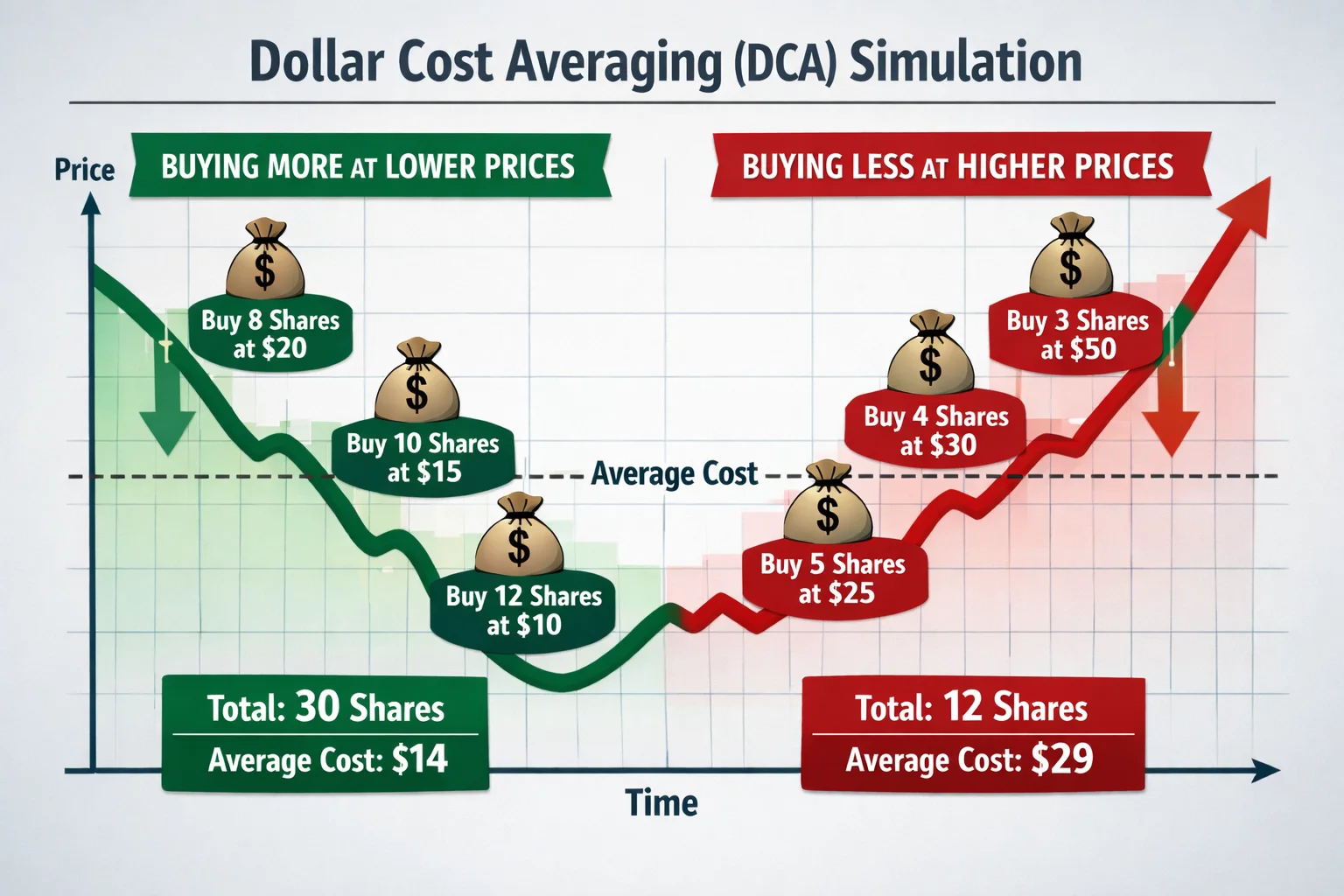
When you invest a fixed amount every month—regardless of the price—volatility actually works in your favor through a process called Dollar-Cost Averaging (DCA).
- When markets are high: Your monthly contribution buys fewer shares.
- When markets are low: Your monthly contribution buys more shares.
This means you are mathematically forced to buy more when things are “cheap.” Over 20 or 30 years, this “mechanical” buying during downturns is what builds the majority of your terminal wealth. Every “red” day is an opportunity to lower your average cost per share.
Reframing the “Drop”
If you have a 20-year time horizon, you should pray for a bear market early in your career. Why? Because you want to accumulate as many shares as possible while they are inexpensive. The “red” you see today is the fuel for the “green” you will spend in retirement.
The only time volatility is truly dangerous is when you are forced to sell. As long as you maintain your Financial Hygiene and keep an emergency fund, you never have to sell at the bottom. You can simply wait for the inevitable recovery.
Don’t Just Feel the Market—Simulate It
It’s easy to stay calm in a bull market, but how will you react when the index drops 20%? The Cortex Index Fund Growth Visualizer allows you to simulate historical volatility for popular ETFs like VOO and QQQM.
See exactly how much “red” occurred in the past and how it set the stage for long-term wealth. Build a portfolio that can weather any storm.